ROI and Maintenance Costs of Requirements as Architecture
Industrial Monorepo Series — Part 6 of 7 1. The Problem · 2. Physical vs Logical · 3. Requirements as Projects · 4. At Scale · 5. Migration · 6. ROI · 7. Inverted Deps
The question isn't whether type-safe requirements are elegant. The question is whether they're cheaper than the status quo. They are — by a wide margin.
The previous five posts described the problem, the solution, the scale characteristics, and the migration path. This post answers the question that management asks: What does it cost, and what's the return?
The Cost of the Status Quo
Before calculating ROI, we need to quantify what the ServiceLocator monorepo costs today. These are conservative estimates for a 15-team organization with a 50-project monorepo.
Developer Time Waste
| Activity | Frequency | Time per Instance | Weekly Cost (15 teams) |
|---|---|---|---|
| "Which code implements feature X?" | 3-5× per team per week | 30 min - 2.5 hours | 45-75 dev-hours |
| Tracing ServiceLocator call chains | 2-3× per team per week | 20-45 min | 20-35 dev-hours |
| "Is this code dead?" investigation | 1-2× per team per week | 15-30 min | 8-15 dev-hours |
| Test environment setup (mock ServiceLocator) | 2-4× per team per week | 15-30 min | 15-30 dev-hours |
| Onboarding: new dev understands 1 feature | ~2 new devs per month | 2.5 hours per feature, ~5 features | 25 dev-hours/month |
| Total weekly waste | 88-155 dev-hours |
At a blended rate of $100/hour (salary + benefits + overhead), that's $8,800 - $15,500 per week in developer time spent navigating a codebase that doesn't explain itself.
Annual cost: $458,000 - $806,000.
Defect Costs
Defects from hidden dependencies and cross-team miscommunication:
| Defect Type | Frequency | Cost per Incident | Annual Cost |
|---|---|---|---|
| Phantom dependency chain bugs | 2-3 per month | $5,000 - $15,000 (investigation + fix + deploy) | $120,000 - $540,000 |
| DI registration errors (production) | 1-2 per month | $2,000 - $8,000 | $24,000 - $192,000 |
| Cross-team contract mismatches | 1-2 per month | $3,000 - $10,000 | $36,000 - $240,000 |
| Stale test / mock divergence | 3-5 per month | $1,000 - $3,000 | $36,000 - $180,000 |
| Total annual defect cost | $216,000 - $1,152,000 |
Compliance and Audit Costs
For regulated industries (healthcare, finance, automotive):
| Activity | Frequency | Cost | Annual Cost |
|---|---|---|---|
| Manual traceability audit | 2-4 per year | $15,000 - $50,000 per audit | $30,000 - $200,000 |
| Audit preparation (developer time) | 2-4 per year | 80-160 dev-hours per audit | $16,000 - $64,000 |
| Compliance remediation | 1-2 per year | $20,000 - $100,000 | $20,000 - $200,000 |
| Total annual compliance cost | $66,000 - $464,000 |
Total Cost of Status Quo
| Category | Conservative | Aggressive |
|---|---|---|
| Developer time waste | $458,000 | $806,000 |
| Defect costs | $216,000 | $1,152,000 |
| Compliance costs | $66,000 | $464,000 |
| Total annual cost | $740,000 | $2,422,000 |
This is the cost of not having logical boundaries — the cost of a 50-project monorepo where nobody knows which code implements which business feature.
One-Time Costs
| Activity | Effort | Cost |
|---|---|---|
| Create Requirements + Specifications projects | 1 dev × 1 week | $4,000 |
| Set up Roslyn analyzer (basic) | 1 dev × 1 week | $4,000 |
| Define 8 feature types + ACs | 1 dev × 2 weeks | $8,000 |
| Create specification interfaces | 1 dev × 2 weeks | $8,000 |
| Migrate 8 features (implementations) | 2 devs × 8 weeks | $64,000 |
| Annotate existing tests with [Verifies] | 1 dev × 2 weeks | $8,000 |
| Cleanup (remove ServiceLocator, distribute Core) | 2 devs × 2 weeks | $16,000 |
| Total one-time cost | $112,000 |
Ongoing Costs
| Activity | Effort | Annual Cost |
|---|---|---|
| Maintain Roslyn analyzer | 0.1 FTE | $10,000 |
| Review Requirements PR changes | ~2 hours/week across teams | $10,000 |
| Define new features (incremental) | ~4 hours per new feature | Included in feature work |
| Total annual maintenance | $20,000 |
Conservative Scenario
Annual savings:  $740,000 (status quo cost eliminated)
Migration cost:  $112,000 (one-time)
Annual maintenance: $20,000

Year 1 ROI: ($740,000 - $112,000 - $20,000) / $112,000 = 543%
Year 2 ROI: ($740,000 - $20,000) / $112,000 = 643% (cumulative)
Payback period: $112,000 / ($740,000 / 12) = 1.8 months
Aggressive Scenario
Annual savings:  $2,422,000
Migration cost:  $112,000
Annual maintenance: $20,000

Year 1 ROI: ($2,422,000 - $112,000 - $20,000) / $112,000 = 2,045%
Payback period: $112,000 / ($2,422,000 / 12) = 0.6 months (< 3 weeks)
ROI Curve
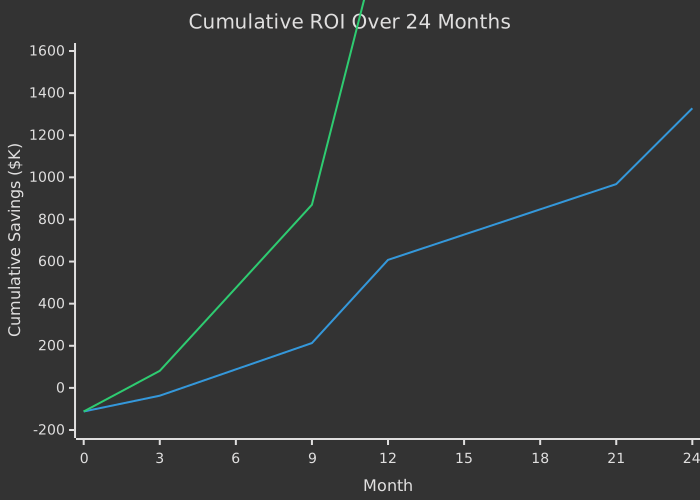
Both scenarios show payback within the first 3 months. By month 12, the conservative scenario has saved $608K. The aggressive scenario has saved $2.3M.
Defect Density
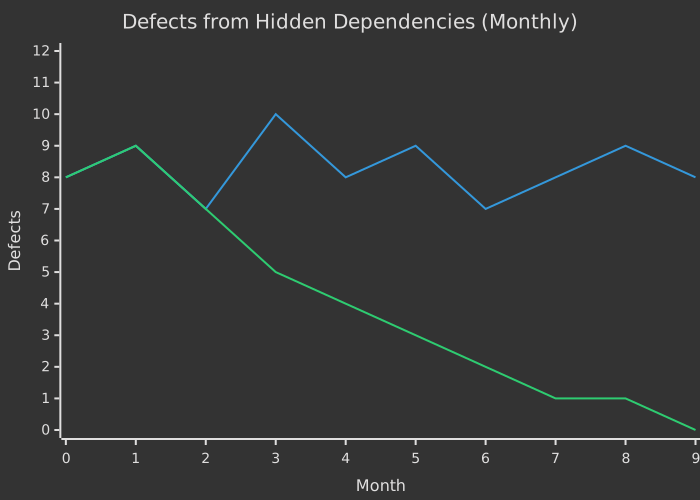
Defects from hidden dependencies (phantom chains, DI registration errors, cross-team mismatches) drop as features migrate to typed specifications. After month 6, they approach zero — because the compiler catches them at build time instead of in production.
Onboarding Ramp
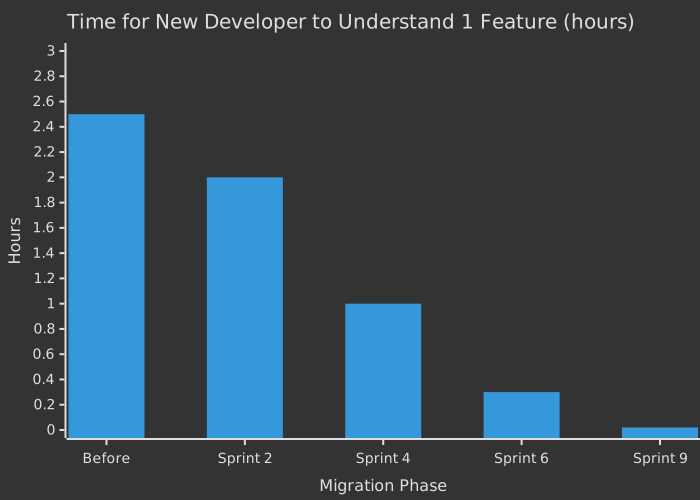
Before migration: 2.5 hours to understand one feature (grep, trace ServiceLocator, read Jira). After Sprint 2: migrated features take minutes; unmigrated features still take hours. After Sprint 9: all features are types — 1 minute per feature.
Build Time Trend
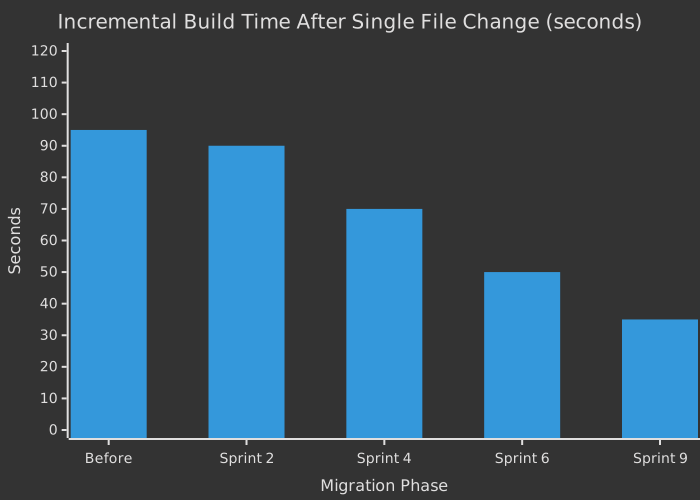
Before migration: changing a file in MegaCorp.Core triggers rebuilds of 40+ projects (95 seconds). As code moves from MegaCorp.Core to feature-specific projects, the blast radius of each change shrinks. After Sprint 9: MegaCorp.Core is deleted; changes to a feature project rebuild only that project and its dependents (35 seconds).
Acceptance Criteria Coverage
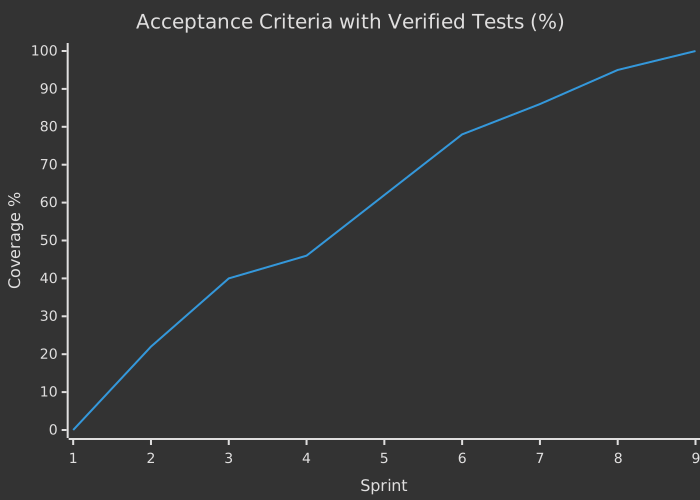
Starting from 0% (no ACs in code) to 100% (all 37 ACs have [Verifies] tests). The curve is not linear — early sprints migrate the largest features (Order Processing has 8 ACs), creating big jumps.
Total Cost of Ownership: 3-Year View
| Year | Status Quo (No Migration) | With Migration |
|---|---|---|
| Year 1 | $740K - $2.4M | $112K (migration) + $20K (maintenance) + $185K (remaining waste during migration) = $317K |
| Year 2 | $740K - $2.4M | $20K (maintenance) = $20K |
| Year 3 | $740K - $2.4M | $20K (maintenance) = $20K |
| 3-Year Total | $2.2M - $7.3M | $357K |
| 3-Year Savings | — | $1.8M - $6.9M |
The migration pays for itself within 2 months. Over 3 years, it saves between $1.8M and $6.9M compared to maintaining the status quo.
Intangible Benefits
Some benefits don't have a dollar value but are strategically significant:
1. Recruitment and Retention
Developers prefer working on well-structured codebases. A monorepo with typed requirements, IDE navigation, and compiler-verified traceability is more attractive than a ServiceLocator spaghetti. This affects:
- Time to fill open positions
- Offer acceptance rates
- Developer retention (reduced turnover)
2. Architectural Confidence
With logical boundaries, teams can make changes confidently. "Will this change break something?" has a compile-time answer instead of a runtime prayer. This enables:
- Faster delivery
- Bolder refactoring
- Less fear of touching legacy code
3. Knowledge Preservation
When a senior developer leaves, their knowledge of "which code implements what" leaves with them. With Requirements as Projects, that knowledge is in the type system. It survives any amount of turnover.
4. Regulatory Readiness
For organizations entering regulated markets (healthcare, finance, automotive), the traceability matrix generated by the Roslyn analyzer satisfies audit requirements out of the box. Without it, achieving compliance requires months of manual documentation.
When NOT to Migrate
This architecture is not free. It has costs. Don't migrate if:
The monorepo has < 10 projects. The overhead of Requirements + Specifications + Analyzers isn't justified for small codebases.
There's only one team. The compiler-as-coordination-mechanism is most valuable for multi-team organizations. A single team can coordinate via conversation.
The codebase is being replaced. If the plan is to decommission the monorepo within 12 months, don't invest in migrating it.
There are no cross-cutting features. If each project is a self-contained microservice with no shared business features, the value of cross-project traceability is minimal.
The team doesn't write tests. Without
[Verifies]tests, the traceability matrix is incomplete. The architecture still provides value (spec enforcement, IDE navigation), but the ROI is lower.
The Executive Summary
| Question | Answer |
|---|---|
| What does it cost? | $112K one-time + $20K/year maintenance |
| What does it save? | $740K - $2.4M per year |
| When does it pay back? | 2-3 months |
| What's the 3-year ROI? | 500% - 1900% |
| What's the risk? | Low — incremental migration, no big-bang rewrite |
| What breaks during migration? | Nothing — old and new architectures coexist |
| Who needs to approve it? | Architecture team + affected feature owners |
| How long does it take? | 9 sprints (4-5 months) for 8 features |
The monorepo doesn't need microservices. It doesn't need a rewrite. It needs two new projects, a Roslyn analyzer, and 9 sprints of incremental migration. The compiler handles the rest.
Series Conclusion
This series started with a question: does Requirements as Code survive at industrial scale?
The answer is yes — not because it's elegant, but because it's structural. The compiler doesn't care how big the monorepo is. It cares whether the types are satisfied. And types scale.
| Post | Key Insight |
|---|---|
| Part 1: The Problem | Industrial monorepos grow organically. ServiceProvider becomes the god-object. Nobody knows which code implements which feature. |
| Part 2: Physical vs Logical | DLLs are packaging, not architecture. Physical boundaries answer "where?" — logical boundaries answer "what?" and "why?" |
| Part 3: Requirements as Projects | Two new projects (Requirements + Specifications) create compiler-enforced logical boundaries. Features are types. ACs are abstract methods. |
| Part 4: At Scale | The AC cascade propagates changes across 15 teams through compiler errors. Feature traceability: 1 second, not 2.5 hours. |
| Part 5: Migration | Incremental migration — one feature per sprint, adapter pattern for legacy code, no big-bang rewrite. |
| Part 6: ROI | $112K investment. $740K - $2.4M annual savings. 2-month payback. 3-year ROI: 500% - 1900%. |
The requirements project is not documentation. It's not metadata. It's a compilation unit — the most important one in the solution. It's where the business tells the compiler what it wants, and the compiler tells the developers what's missing.
Physical boundaries are packaging. Logical boundaries are architecture. The compiler enforces both. That's what scales.